Why Tennis Scoring Counts Love, Fifteen, Thirty and Forty
Understand tennis scoring from love to forty, including deuce, advantage and tiebreaks, so you can follow points, games and sets without losing track.
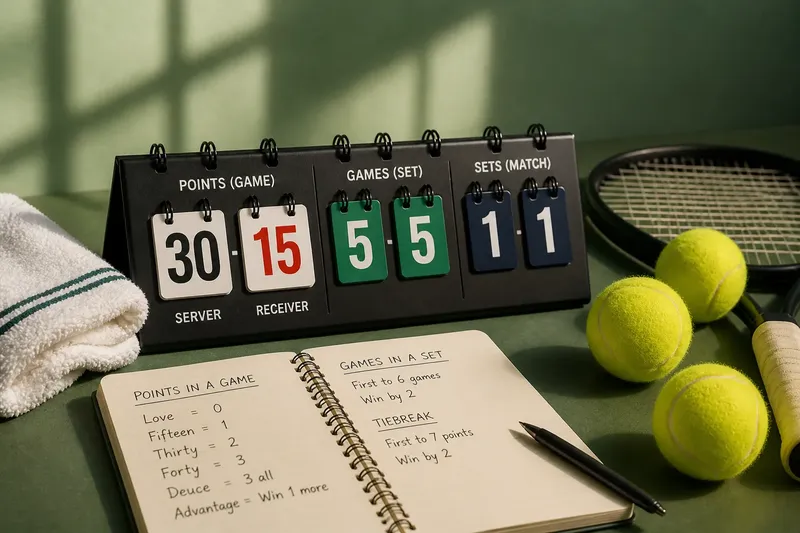
The common mistake in tennis scoring is to hear “thirty” and think it means thirty points. It means the player has won two points in the current game; love, fifteen, thirty and forty are labels, not a running count of every point played. Keep the game, set and match levels separate and the calls become easier to follow.
Points belong to a game, not to the whole match
A tennis match is organised into sets, sets into games, and games into points. The point score starts afresh whenever a game ends, while the game count starts afresh at the beginning of each set.
In the usual spoken call, the server’s score comes first. If the server has won two points and the receiver one, the score is “thirty-fifteen”. Those words describe only the current game.
A score might read “Player A leads four games to three, thirty-fifteen”. The first pair is the game count in the set; the second pair is the point count in the game. It is like a set of nested drawers: each label tells you which level you are looking at.
Love, fifteen, thirty and forty mark points in a game
“Love” means no points in the current game. After one point, a player has fifteen; after two, thirty; after three, forty. The names do not match the number of points won, but they are the standard calls.
Say the receiver wins the first point, then the server wins the next two. The calls move from fifteen-love to fifteen-all, then to thirty-fifteen. “All” means both players have the same point score in that game; it does not say that the set or match is tied.
Reaching forty does not always finish the game. If the opponent also reaches forty, the score is deuce and a margin is still needed.
Deuce and advantage keep a game open
At deuce, both players have won at least three points and are level. Under the standard advantage system, a player must win two consecutive points from deuce: the first gives advantage, and the second wins the game.
If the player with advantage wins the next point, the game ends. If the opponent wins it, the score returns to deuce. The players can move between deuce and advantage repeatedly.
“Advantage server” means the server won the point after deuce; “advantage receiver” means the receiver did. The next point either decides the game or restores deuce.
Some competitions use a deciding point at deuce instead. In that format, the next point wins the game, and the receiver chooses the side from which to receive. Check the competition rules or match display to see which system applies.
A game score and a set score answer different questions
Winning a game adds one to a player’s game total in the set. A player generally needs to reach six games and lead by two to take a set. If the players reach six games each, many formats use a tiebreak, though the precise set-ending arrangements depend on the competition.
“Forty-thirty” describes an unfinished game. “Five games all” describes the set’s game count. A match score such as one set all tells you how many sets each player has won, not the current points or games.
Imagine the board shows one set each, the current set at five games all, and the next game at thirty-fifteen. The players have completed one set apiece; they have each won five games in the current set; and the server leads by one point in the current game. All three details can be true at once because they describe different levels.
Tiebreak points use ordinary numbers
A tiebreak settles a set when the players reach a specified game score. Its points are counted in ordinary numbers rather than love, fifteen, thirty and forty. Many formats require a player to reach at least seven points and lead by two, but the target can differ by competition.
During a tiebreak, “six-five” means the players have won six and five tiebreak points. It does not mean the set is six games to five. The tiebreak sits inside the set, but uses a different point-counting language.
Service follows a special rotation: one player serves the opening point, then service alternates in blocks of two points. Players change ends at the intervals set by the rules. The useful distinction is that a tiebreak point total is not a game score.
Why does tennis use this scoring language?
Why does love mean zero?
“Love” is the word for a score of zero in a game. Its origin is often linked to the French word for egg, l’œuf, because an egg resembles a zero, though the historical explanation is not settled. For following play, the meaning is simple: no points won in that game.
Why does the score stop at forty?
The game score moves from fifteen to thirty to forty, then uses deuce and advantage if the players are level. One explanation treats forty as a shortened form of an earlier counting pattern, but accounts of the scoring system’s development vary. Players do not need to settle the history to read the score.
Does the server’s score always come first?
In the usual spoken call, the server’s score comes first, followed by the receiver’s. “Love-thirty” therefore means the server has won no points and the receiver has won two. Match graphics may show each score beside a player’s name, so read the names as well as the order of the numbers.
Can a game end at forty-all?
Under the standard advantage system, forty-all is deuce, and a player must win two points in a row from there. Under a deciding-point format, the next point after deuce can end the game. The competition rules determine which system is used.
Name the level to keep the score readable
When a score seems confusing, ask what it counts: points in the current game, games in the current set, or sets in the match. Love through forty and deuce describe game points; ordinary numbers during a tiebreak describe its points; a score such as six games to four describes the set.
This is the useful habit for reading tennis scoring: identify the level before interpreting the number. When a commentator says “thirty-forty”, the receiver is one point from taking the game under the usual scoring system; if the server wins, the score returns to deuce.