A First Grand Slam Draw: Finding Your Bearings
A first Grand Slam draw becomes easier to follow when you can read the brackets, seeds and possible routes without mistaking them for predictions.
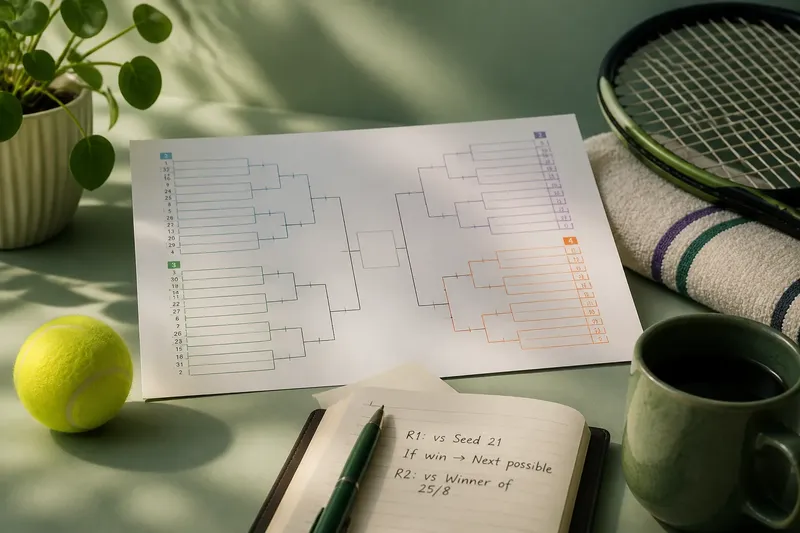
The most common mistake with a first Grand Slam draw is treating its neat lines as a forecast. A first Grand Slam draw shows the route a player would have to take, and that route can change as soon as a match is played; read it as a map, not a promise.
Start with the side of the draw
In a singles draw, each player occupies a line in a bracket. Lines join to show which players could meet in a later round, provided they win their earlier matches. The diagram is a record of possible pairings, not a list of matches already scheduled.
Grand Slam singles draws are divided into two halves, usually labelled the top and bottom. Each half contains quarters, and those quarters break down into smaller sections. Follow the connecting lines outward from a player’s name to see the next possible opponent, then the possible opponent after that.
Think of the bracket as a set of railway connections printed before the trains run. The route exists on paper, but the passengers still have to arrive. A player advances only by winning the match in front of them; the other branch does not quietly disappear because its name looks less familiar.
Read the seed as a placing, not a verdict
A seed is an assigned position in the draw, generally reflecting a player’s standing under the tournament’s seeding arrangements. Seeded players are placed in different parts of the bracket so that the leading names are less likely to meet in the opening rounds. Seeding shapes the draw; it does not decide the matches.
The number beside a name is not a score, a ranking displayed in full or a measure of how the player will perform that day. A high seed may face a difficult first opponent, while a lower-ranked player may be in excellent form. The seed is useful context, not a substitute for watching.
Some players enter without a seed. They may still be established professionals, qualifiers who came through preliminary matches, or wildcards admitted by the organisers. An unseeded name can therefore be unfamiliar without being an easy opponent.
Track the route one round at a time
Choose a player and locate the line beside their name. Then read only as far as the next joining point: that is the next potential opponent, not necessarily a confirmed fixture. Once both players have won their matches, the pairing becomes real. Repeat the process after each round.
For a useful note, write down the player’s current opponent and the names in the next section of the bracket. Avoid copying a long chain of speculative match-ups. A tidy path can look persuasive on a screen, but every unplayed match is still an open question.
Say you are following an unseeded player whose first match is against a seed. If the unseeded player wins, the bracket points to a possible next opponent from the adjoining pair of lines; that player must win too. Your note can record the actual first-round result and the next possible pairing, without declaring a route to the final.
Why does a draw sometimes look uneven?
Why are some players given a bye?
A bye means a player advances past the opening round without playing it. Draw sizes and tournament arrangements can leave some places unpaired in that round, so the bracket shows a direct route to the next one. It is an administrative feature, not a win over an opponent.
What does a qualifier or wildcard label mean?
A qualifier earned a place through qualifying matches, while a wildcard received entry through the tournament’s allocation. Both labels explain how a player entered the main draw, not how strong they are or how far they are expected to go.
Can two familiar players meet early?
Yes. The draw’s placement of seeds can keep some leading players apart until later rounds, but it does not separate every well-known player from every other one. If two names sit in the same small section, they could meet early, assuming both advance.
Why did the opponent change on the schedule?
A listed pairing can change when a player withdraws or is unable to continue under tournament procedures. The draw and the daily order of play serve different purposes: one shows possible progression, while the other identifies matches arranged for that day.
Keep the draw separate from the day’s schedule
A draw is not the same thing as the order of play. The order of play tells you which matches are set for a particular court and session; the draw shows where their winners could go next. A name visible in the bracket may not be playing that day, and a scheduled match may be delayed or moved.
At a Grand Slam, singles, doubles and mixed doubles have separate draws. Check the event heading before following a name: a player can appear in more than one competition, and the same surname in another draw may belong to a different person. Court assignments and match times are better checked against the current daily schedule than inferred from bracket position.
Use the bracket to shape a day of viewing
Before watching, note the round, the players’ seeds if shown, and the next possible pairing. During the match, the draw can help explain what is at stake in tournament terms: a win advances the player into a particular part of the bracket, while a loss ends that route in that event. It cannot tell you how the match will unfold.
Afterward, update only what has happened. Cross out the defeated branch or mark the winner through to the next round, then wait for the adjoining match before treating the next pairing as settled. This small habit makes a first Grand Slam draw easier to read without turning it into a prediction contest. The bracket tells you where the next question lies; the players supply the answer.