The Myth That Every Clay Court Plays the Same
Clay court differences come from more than the surface label. Learn how upkeep, weather and court conditions shape movement, bounce and match tactics.
The most common mistake about clay courts is treating “clay” as a playing description. That shortcut can cost a player useful preparation: one court may reward patience and high-margin shots, while another feels quicker and more direct. Construction, upkeep and conditions all shape clay court differences.
The label identifies a broad surface category, not a promise that two courts will look, feel or play alike. Red and green clay, for instance, can use different materials and construction methods. Even courts at the same venue can vary as moisture, temperature and maintenance change the playing layer.
Clay names a category, not a single recipe
“Clay court” commonly describes a playing layer of loose mineral material over a prepared base. The exact composition varies. Red clay often uses crushed brick or similar material, while green clay is often made from crushed stone; neither colour fully describes what lies beneath a player’s shoes.
Construction matters because the visible surface sits within a larger system. The base, drainage, depth and compactness of the top layer influence how the court takes water and how loose material sits underfoot. Players need not know the engineering specification to notice a difference, but the same surface name should not be mistaken for identical construction.
Colour is a clue, not a diagnosis. A court’s appearance may suggest a material or maintenance style, while its feel depends on the playing layer that day. A red court with a thin, dry layer may behave differently from one with a more compacted or damp surface.
Upkeep changes what a player encounters
Clay courts need regular attention because play shifts their loose surface. Brushing redistributes material, watering controls dust and moisture, and rolling can help maintain an even playing layer. The aim is to keep a particular court playable, not to make every court identical.
Timing and technique matter. A court watered shortly before play may feel different from one left dry, while heavy traffic can leave marks or uneven patches. Players should not assume every venue prepares its courts in the same way or at the same point in the day.
Maintenance also helps explain why the same court can change during a session. Footprints and slide marks accumulate; loose material moves towards the edges; service boxes and baselines see repeated traffic. A player who notices those changes has more useful information than one relying on the venue’s surface label.
Weather alters the surface during play
Moisture is one clear influence on clay. A damp surface may feel more compact, and the ball can pick up material as it bounces. A dry court can be dustier, with loose particles more apparent underfoot. These are tendencies, not fixed laws: material, drainage, preparation and the amount of moisture all matter.
Temperature, sunlight and wind contribute too. Sun can dry exposed areas while shaded sections remain damp; wind can move loose material or make a toss less predictable. Wet clay can become slippery or unsuitable for play, so follow the venue’s direction rather than treating a safety decision as a test of grit.
Conditions can differ between the two ends. One baseline may receive more sun, or a patch near the net may hold moisture. Watch a few rallies and compare how the ball travels and how your shoes grip in different areas before committing to a tactical adjustment.
Read the court before choosing a default plan
Clay is associated with longer rallies because the surface often slows the ball and allows players time to recover. But that broad tendency is not a script. A court’s pace, bounce and grip can alter the value of heavy topspin, a flatter drive, a drop shot or an early move forward. The useful question is what this court is doing today.
During warm-up, watch the bounce on a rally ball and a shorter ball. Notice whether the ball rises high or stays comparatively low, and whether it skids or loses pace. Check whether you can stop, change direction and slide under control. Sliding is a movement choice, not a requirement imposed by the surface.
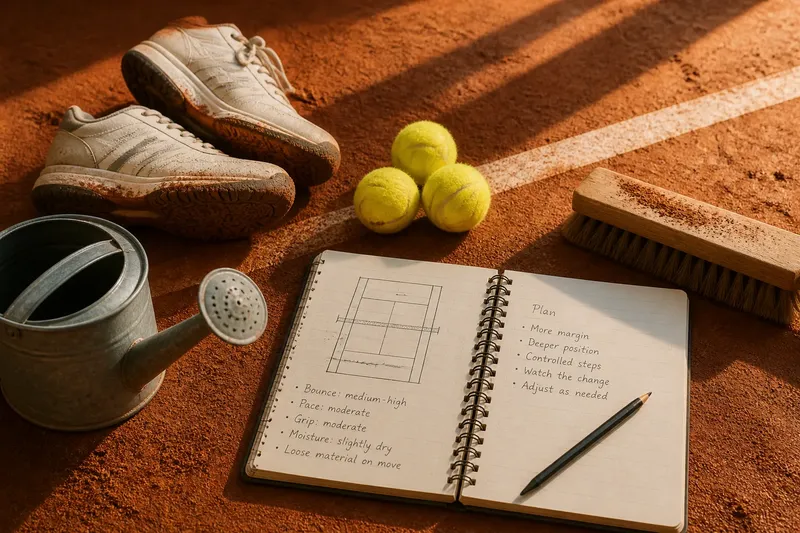
Say you arrive at a dry outdoor court and, in this invented situation, your first warm-up balls kick up high while loose material shifts underfoot as you change direction. You start with more margin over the net, stand farther behind the baseline and use controlled steps instead of forcing a slide; the observable result is that your early shots clear the net comfortably and your footing stays settled. Later, if the bounce proves lower or grip firmer, you adjust your contact point and movement rather than clinging to the first impression.
Think of the surface like a kitchen floor: “tile” tells you something, but not whether it is dry, dusty or freshly mopped. The analogy has limits, since a tennis court is shaped by construction, weather and ball interaction, but it captures why a category name is not a complete description.
Common clay court questions have conditional answers
Does clay always slow the ball down?
Clay often produces a slower-playing feel than harder surfaces, but material, preparation and conditions affect the result. Judge the actual bounce and pace rather than assuming every clay court behaves alike.
Why does the ball bounce differently on two clay courts?
The playing layer, underlying construction, moisture and wear can all affect the bounce. Even on one court, sun, shade and traffic may create local differences that become visible during a match.
Is red clay always slower than green clay?
Colour alone cannot settle that comparison. Materials and preparation differ by venue, and the day’s conditions can matter as much as the broad colour label.
Should I slide on every clay court?
No. Sliding depends on the court’s grip, your balance and your movement skill, not merely on the surface category. If your footing feels uncertain, use controlled steps and avoid forcing a slide.
Use a simple routine to update your read
A repeatable routine helps separate an early impression from a useful match-day read. Notice a few features, then revise your plan when the evidence on court changes.
- Before play: If you see damp, dusty or visibly uneven areas, ask the venue about court-specific guidance; if the surface appears even, still check for any staff instructions before starting.
- During warm-up: If rally balls and shorter balls bounce differently, note both responses and adjust your contact point to suit; if they behave similarly, begin with your usual shot selection and keep observing.
- On movement: If ordinary stops and turns feel secure, use normal movement and consider a controlled slide only if it suits your skill; if your shoes slip or catch unpredictably, use smaller steps and do not force a slide.
- Across the court: If sunlit and shaded areas feel different underfoot or produce different bounces, allow for the difference when choosing position; if they seem alike, avoid making an adjustment without another sign.
- After a change in weather: If rain, sun or wind has altered the surface, reassess bounce and footing before resuming your plan; if conditions appear unchanged, continue to monitor rather than assuming they will stay that way.
- Between games or sets: If wear or maintenance has visibly changed the playing layer, adjust shot shape or recovery position where the change matters; if the court looks and feels consistent, keep the existing plan.
For court use, venue instructions and the surface manufacturer’s guidance take precedence over general advice, particularly after rain or maintenance. You need not identify every material in the court to make a sound decision; if conditions feel unsafe, stop and ask staff.
Let observation outrank the label
Clay court differences come from the interaction of surface material, construction, upkeep and conditions. The category remains useful as a starting point, not a forecast. Paying attention to bounce, grip and changing conditions helps you choose sensible margins and movement without pretending to know the court’s full specification.
On your next clay court, keep the surface name in mind but let the first rallies do the explaining. If the court changes, update your read. That modest habit is more dependable than expecting every patch of clay to play by the same rules.